Westchester County
Slate & Cedar Roofing in Scarsdale, NY
The Greenwich Slate & Cedar Roof Guide explains slate, cedar and tile roofing for homeowners in Scarsdale, NY.
Most slate roof work in Scarsdale is repair, not replacement: valleys, chimney flashing and slipped slates on steep Tudor roofs. Flashing and valley repairs on these houses typically run $2,000–$8,000; full natural slate replacement is $30–$60 per sq ft and is rarely the first answer on a sound 1920s roof. A careful inspection with photos is the right first step.
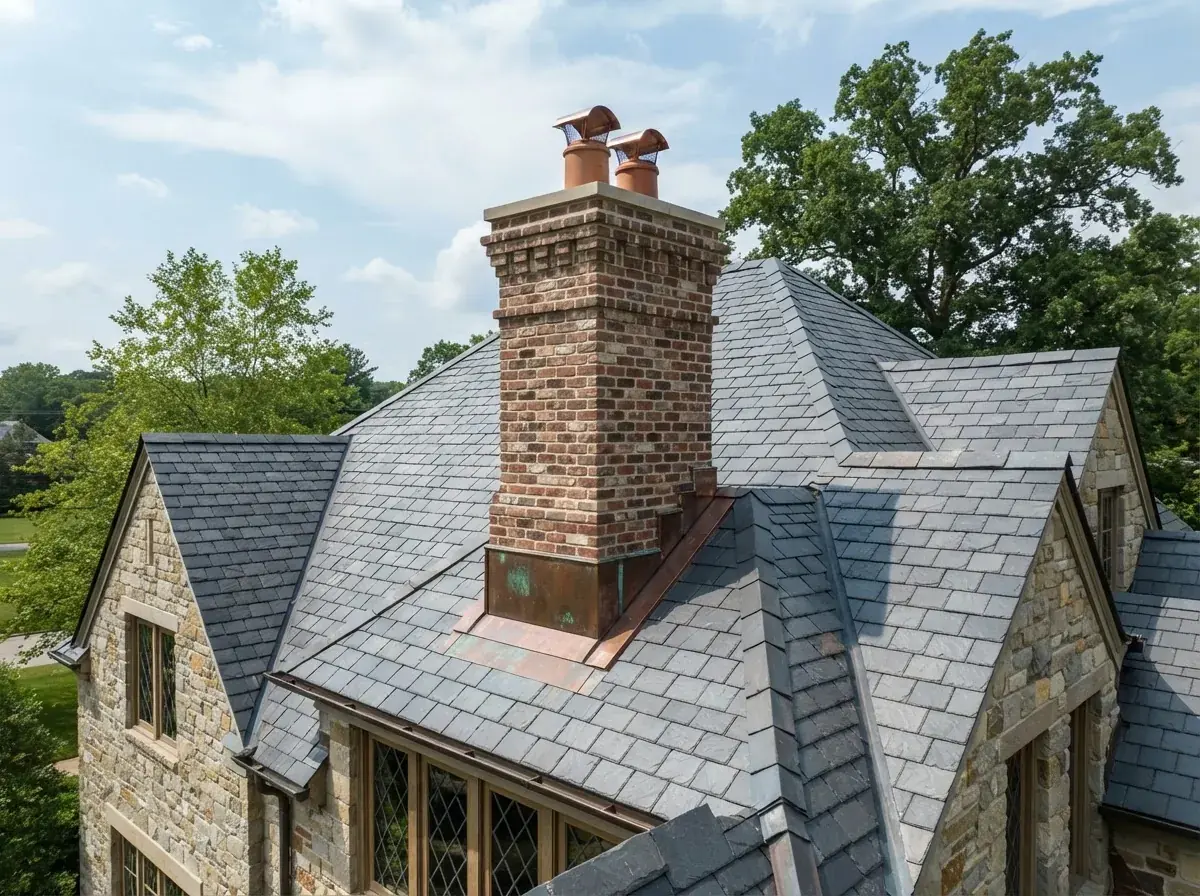
- Tudor roofs leak at valleys and chimneys first
- Original slate often outlasts its flashing
- Built-in gutters need relining, not just cleaning
- Mature trees fill valleys every fall
Scarsdale's Tudor and Colonial Roofs
Scarsdale is known for its 1920s and 1930s Tudor and Colonial homes, many in Fox Meadow, Greenacres and Heathcote, and a large share of them still have their original slate roofs. Suburban building began in 1891, when a developer turned a 150-acre farm into one-family house lots; the village itself was incorporated in 1915. Scarsdale is a coterminous town and village, so permits and preservation questions go to the Village of Scarsdale.
The village groups its 17 neighborhoods into five areas that match its elementary schools: Edgewood, Fox Meadow, Greenacres, Heathcote and Quaker Ridge. More than 90 percent of homes are owner-occupied, which shows on the roofs: many have been patched by several owners over several decades, and those patches are where trouble hides.
Steep, complex rooflines
Scarsdale Tudors typically have steep, complex roofs with multiple gables, valleys, dormers and large chimneys, often in slate. Those details, more than the slate itself, are where leaks usually start.
Half-timber and stucco junctions
Where a slate roof meets stucco or half-timbered walls, the flashing is often tucked behind finishes. Leaks there show up as stains well away from the real source.
Colonial Revival homes
Simpler roof forms, but often with slate or cedar on the main house and a later addition in asphalt. The joint between old and new roof is a common leak point.
Slate That Outlasts the Flashing
Natural slate on a 1920s Scarsdale house may have decades of life left while the original flashing, valleys and nails are failing. Targeted repairs and new copper flashing are often far cheaper than a new roof. A tear-off throws away slate that, in many cases, would outlast the replacement.
What a good repair on a Scarsdale Tudor usually includes:
- Rebuilding open valleys in 16- or 20-ounce copper, lifting and relaying the slate on each side.
- New step and counter flashing at chimneys, cut into the mortar joints rather than surface-sealed.
- Replacing broken slates with matched salvaged or new slate of the same size, color and thickness.
- Checking the ridge, which on steep roofs is often finished in slate saddle or copper and is easily damaged by careless foot traffic.
Watch for roofing cement smeared over flashing. It is a sign of an earlier quick fix, and it usually means the flashing beneath needs replacing.
Built-In Gutters and Ice Dams
Many Scarsdale houses of this era have built-in or box gutters hidden in the eave. When the lining fails, water goes into the cornice and walls rather than over the edge, and the damage can be extensive before anyone sees a stain. Relining in copper is the lasting repair.
Large old trees in Fox Meadow and Greenacres mean debris in valleys and gutters and the risk of limb damage in storms. Clearing valleys and checking for broken slates after storms prevents slow leaks. In winter, blocked gutters and cold eaves combine into ice dams; snow guards and ice-and-water underlayment at the eaves, installed during any eave repair, help.
Historic Preservation Review in Scarsdale
Scarsdale's Committee for Historic Preservation reviews applications to demolish homes and can find that a house meets the village's criteria for preservation; such a finding can delay demolition for up to ten months. The village has six places on the National Register of Historic Places, including Wayside Cottage and the Caleb Hyatt House. Keeping an older home's roof sound is part of keeping its character, and roof repairs themselves generally need only a building permit where the code requires one.
Westchester County requires home improvement contractors, roofers included, to hold a county home improvement license, and homeowners can check a contractor's license number with the Westchester County Department of Consumer Protection before signing anything.
Common Roof Work in Scarsdale and Typical Costs
| Issue | Typical fix | Typical range |
|---|---|---|
| Water stain under a valley | Rebuild the valley in copper, relay slate | $2,000–$8,000 |
| Chimney leak | New copper step and counter flashing | $1,200–$4,000 |
| Slipped slates after winter | Matched slate replacement | $500–$2,500 |
| Rotted built-in gutter lining | Reline in copper or replace with half-round | $40–$80 per linear ft |
| Ice sliding off a steep slope | Snow guards above entries and gutters | $1,500–$6,000 |
| Condition report before buying a house | Slate roof inspection with photos | $250–$600 |
Ranges are typical for Fairfield County and Westchester in 2026 and are for planning only. They are not quotes; the real price depends on the roof, access and materials.
Buying or Selling a Slate-Roofed House in Scarsdale
Houses change hands often enough in Scarsdale that the roof comes up at almost every sale. A general home inspector will note that a roof is slate and may flag stains or missing pieces, but most won't walk a steep slate roof. For a 1920s Tudor, a separate inspection by someone who works on slate is money well spent.
What a buyer should ask for:
- The type and condition of the slate itself: hard and sound, or soft, flaking and delaminating.
- The condition and material of valleys and flashing, and whether they have been renewed.
- Evidence of earlier patching with roofing cement or mismatched slate.
- The state of built-in gutters, which can hide expensive problems.
- A rough split between work needed now and work that can wait five years.
For a seller, fixing flashing and replacing broken slates before listing is usually cheaper than the price reduction a buyer will ask for once their own inspector raises the roof.
Matching Slate on a Scarsdale Roof
The slate on most Scarsdale Tudors came from Vermont, New York or Pennsylvania quarries, in grays, greens, purples and mottled mixes. Some colors weather ("fading" slate turns from gray-green to buff or brown), while "unfading" slate keeps its color. A good repair matches the weathered color of the roof as it looks today, not the color the slate was in 1925.
Matching also means size and thickness. Tudor roofs were often laid with graduated courses, larger and thicker slates at the eaves and smaller ones toward the ridge, and some used random widths for a rustic look. A roofer who keeps a stock of salvaged slate can often find a close match; otherwise new slate from the original quarry region is the next best option. Either way, each replacement slate should be hung on a copper or stainless hook or nailed with copper, never glued in with roof cement. Glued slates come loose within a few winters and leave tar stains that are hard to clean off.
Slate & Cedar Roofing: Common Questions
How often should a slate roof in Scarsdale be checked?
Every two to three years, and after any major storm. Look for slipped slates, debris in valleys and stains on upper-floor ceilings. Catching a few broken slates early costs far less than repairing plaster and framing after a winter of slow leaks under a blocked valley.
Should I replace the original slate on a 1920s Scarsdale Tudor?
No, not usually. If the slates are hard, ring when tapped and aren't flaking across whole slopes, renewing the flashing, valleys and fasteners is the better value. Replacement makes sense when the slate itself is failing.
Do I need approval to re-roof a historic house in Westchester?
It depends on the municipality and whether the home is a designated landmark or inside a local historic district. Several Westchester towns and villages require a certificate of appropriateness for exterior alterations to designated properties. Check with the building or planning department before changing roofing materials.
Before you hire
Check the Contractor First
Roofing on an existing home is home improvement in Connecticut: the contractor must be registered with the Department of Consumer Protection and show the HIC number in its ads and contract. Westchester County licenses home improvement contractors the same way.
- Look up a Connecticut HIC registration
- Search Westchester County licences
- Questions to ask a slate or cedar roofer
This site is an independent guide. It doesn't perform roofing work or recommend a particular company.