Greenwich, CT · Fairfield County · Westchester
Copper Gutters in Greenwich, CT
The Greenwich Slate & Cedar Roof Guide explains copper gutters for homeowners in Greenwich, CT and surrounding towns including Stamford, Darien and New Canaan.
Installed half-round copper gutters typically run $40–$80 per linear ft in Fairfield County and Westchester, several times the price of aluminum, and they last several times as long. Most houses take one to three days, depending on how many runs, leaders and conductor heads there are. Copper suits slate, tile and cedar roofs that are built to outlast the gutters hung on them.
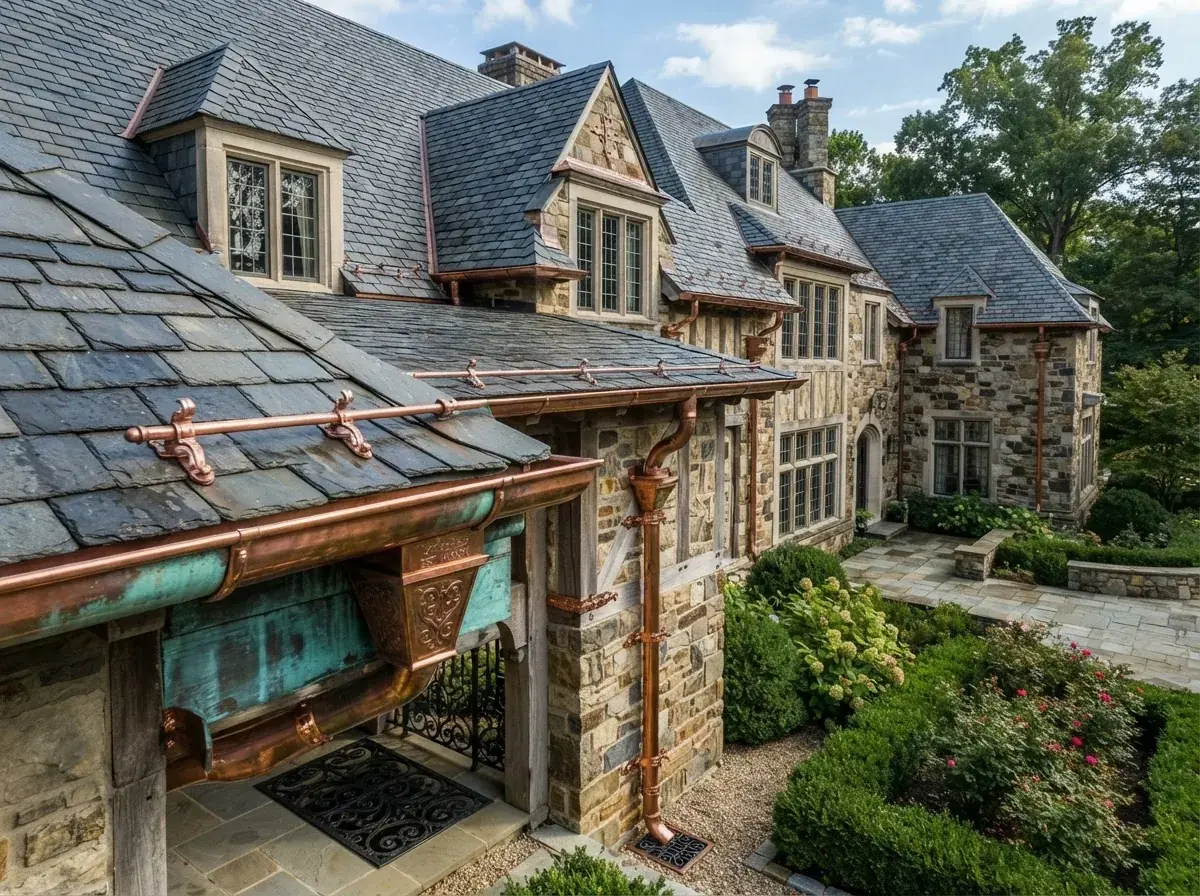
- 16 oz or 20 oz cold-rolled copper
- Soldered seams and outlets, not caulked
- Copper or brass hangers only
- Patina from bright to brown to green
Types of Copper Gutters and Accessories
Half-round gutters
The traditional profile on Colonial, Tudor and Shingle-style houses. Common sizes are 5 and 6 inches; 6-inch handles the long runs and steep slate pitches that dump water fast. Single-bead, double-bead and reverse-bead edges change the look and stiffness.
K-style (ogee) gutters
A flat-backed profile that sits tight to the fascia and carries more water than a half-round of the same width. A common choice on newer houses where the trim was designed for it.
Built-in and box gutters
Gutters built into the roof edge or cornice, common on older Greenwich and Westchester houses. They're lined with copper sheet, and a failing lining leaks straight into the wall, so relining is often more urgent than it looks.
Round leaders (downspouts)
Plain or corrugated round copper leaders, 3 or 4 inches, held with copper or brass straps. Sizing leaders to the roof area matters as much as gutter size.
Conductor heads
Decorative leader heads, also known as leader boxes, that collect water where a gutter or scupper meets a leader. They add capacity at outlets that tend to overflow, and they're a period detail on many older houses.
Hangers, straps and guards
Copper or brass hangers spaced closely enough to carry ice and snow load. Leaf guards on wooded lots, chosen so they don't trap debris against the copper.
How Copper Gutters Are Installed
- Measure and plan. Each run is measured, outlets are placed so no section carries more roof than it can drain, and leader positions are agreed before any metal is cut.
- Remove the old gutters. This is when rotted fascia and rafter tails show up. A careful estimate leaves room for some carpentry instead of hiding it.
- Set the pitch. Gutters slope gently toward outlets; too much pitch looks crooked on a long facade, too little leaves standing water.
- Hang and solder. Sections are joined with lapped, soldered seams. Outlets and end caps are soldered too. Sealant-only joints on copper are a shortcut that fails.
- Leaders and heads. Leaders are strapped to the wall with copper fasteners and led to drains or splash blocks, away from foundations.
- Water test. A hose test on each run confirms there's no standing water and every seam is tight.
On a slate roof, the edge slates sit right above the gutter, so hangers that fasten under the starter course need a roofer who works on slate. Breaking edge slates while hanging gutters is a common and avoidable problem.
16 oz or 20 oz Copper: Choosing the Gauge
Copper sheet is sold by weight per square foot. Most residential gutters are formed from 16 oz or 20 oz cold-rolled copper, and the Copper Development Association's own hung-gutter details are drawn in 20 oz.
- 16 oz is the usual choice for 5-inch gutters on modest runs and costs less.
- 20 oz is stiffer and resists denting from ladders, ice and falling branches. It's worth it on 6-inch gutters, long runs, and wooded lots in North Stamford, Bedford or Pound Ridge.
Ask what weight is priced for each part: gutters, leaders and conductor heads are sometimes priced in different gauges.
What Affects the Cost of Copper Gutters
Most jobs land in the $40–$80 per linear ft range. Where a given house falls depends on:
- Height and access. Third-floor eaves, steep lots and landscaping that blocks ladders add labor.
- Profile and size. 6-inch half-round in 20 oz costs more than 5-inch in 16 oz.
- Number of corners, outlets and leaders. Each mitred corner and outlet is soldered by hand.
- Conductor heads and custom pieces. Decorative heads and scuppers add cost per piece.
- Fascia and rafter repair. Rot found behind old gutters is common on older houses.
- Built-in gutters. Relining a box gutter is a different job, priced on its own.
Ranges are typical for Fairfield County and Westchester in 2026 and are for planning only. They are not quotes; the real price depends on the roof, access and materials.
Copper Gutters Near Long Island Sound
Copper holds up well in salt air, which is one reason it's common along the shore from Old Greenwich to Rye. The patina forms faster near salt water, moving from bright copper to brown and, over years to decades, to the familiar blue-green. If you want the bright look, it has to be cleaned and lacquered regularly; most owners let it weather.
Two cautions apply everywhere. First, water that runs off copper will corrode aluminum and galvanized steel below it, so mixed-metal gutter systems and aluminum flashing downstream of copper are a mistake. Second, copper runoff can stain light stone and stucco green; leaders and splash blocks should send water away from pale masonry.
Copper Gutters: Common Questions
How long do copper gutters last?
Well-made copper gutters commonly last 50 years or more, and many older houses still have their original copper. The weak points are solder joints, hangers and the fascia behind them, which is why a yearly check is still worthwhile.
Will copper gutters turn green?
Yes, eventually. Copper darkens to brown within months and slowly develops a blue-green patina over years to decades, faster near salt water. The patina protects the metal. It can be kept bright with cleaning and lacquer, but that needs repeating.
Can copper gutters be used with an aluminum or steel roof edge?
No, not where water runs from copper onto aluminum or galvanized steel. Copper runoff corrodes those metals. Drip edges, flashing and leaders in the same water path should be copper or another compatible metal.
Are copper gutters worth it on a cedar roof?
Yes, in most cases. Copper outlasts cedar, so the gutters will serve through at least one re-roof, and trace copper in the runoff does not harm the shakes above it. Make sure the gutters are hung so the bottom course of shakes can be replaced later without taking them down.
Before you hire
Check the Contractor First
Roofing on an existing home is home improvement in Connecticut: the contractor must be registered with the Department of Consumer Protection and show the HIC number in its ads and contract. Westchester County licenses home improvement contractors the same way.
- Look up a Connecticut HIC registration
- Search Westchester County licences
- Questions to ask a slate or cedar roofer
This site is an independent guide. It doesn't perform roofing work or recommend a particular company.